Marketing
One campaign, four branches
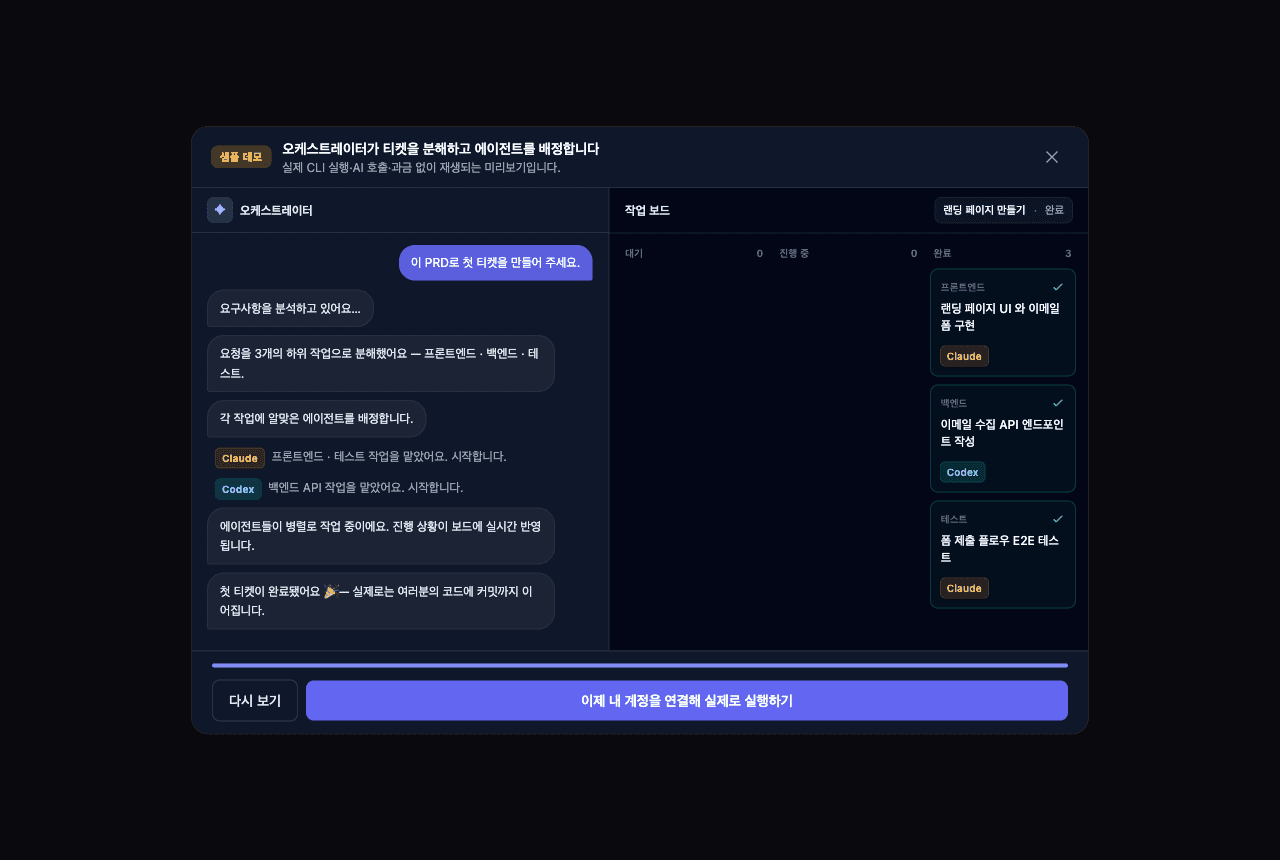
Creative copy, audience segments, landing text, and budget scenarios run at once. Sequentially that is four days; branched, four versions land in one and the person only picks.
AI AGENT ADOPTION
Not a tool sale. We decide what should be automated, put the controls in place, and stay until the team actually uses it.
You already use AI coding tools. The gap is not tooling. Everyone picked their own, and at the company level nothing is visible.
Usually it is. Claude Code and Codex are good tools, and for one task at a time they are plenty. We use them the same way.
It breaks when one becomes two, and two becomes five. Past that point, keeping track of the agents takes longer than running them. Here is where it actually breaks.
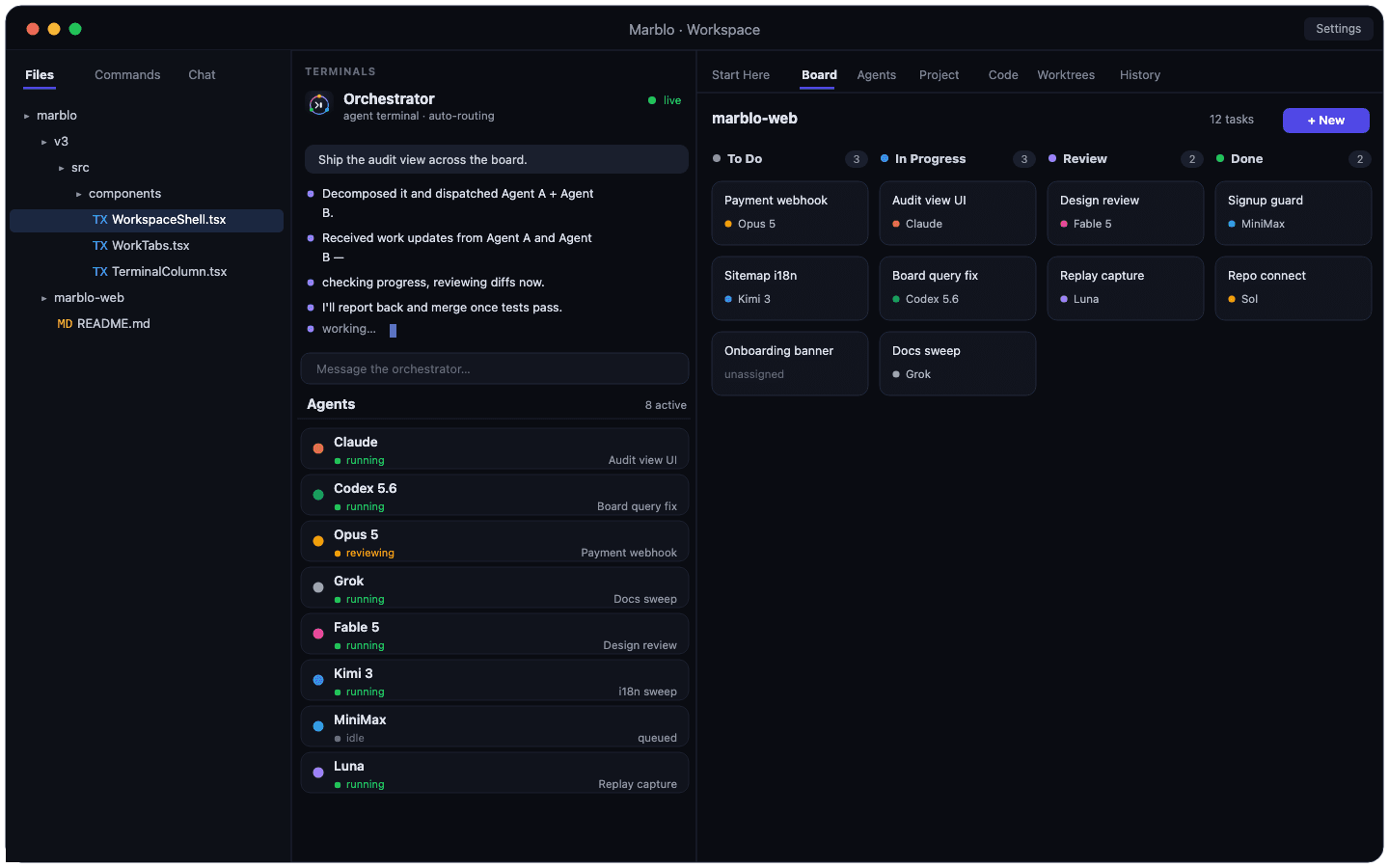
More terminal windows means more agents. But from the third one on, you no longer know which window finished what. You did not add capacity, you added things to miss.
MARBLO
Everything lands on one screen. You read state, not a chat log.
Two agents in one repository overwrite each other. You end up running them one after another anyway, which defeats the point of parallel.
MARBLO
Each ticket gets its own git worktree. They physically cannot touch each other's files.
Review depends on someone remembering. When it gets busy, it gets skipped. A written policy is a document, not a flow.
MARBLO
Work has to pass REVIEW before it merges. The flow enforces the policy, not a document.
Claude Code is Claude. Even when Codex fits this ticket and Grok fits that one, changing the model means changing the tool. You end up tied to one vendor.
MARBLO
Assign a model per ticket. One vendor wobbling does not stop the work.
There is no way to see who spent how many tokens on what, as it happens. You cannot budget, and you cannot catch an overrun.
MARBLO
Usage and spend land in the workspace by vendor, model, and agent — down to which model each agent actually ran.
The code survives; why it was done that way leaves with the chat window. Months later you re-derive it from scratch.
MARBLO
An append-only record per ticket. You can retrace which agent changed what, and on what grounds.
Agents are cheap to start. Knowing what the fleet is doing is the hard part.
Marblo official repository
Running agents in parallel is not the hard part. The hard part is running them in parallel while still knowing what changed and keeping a human on the final approval. What actually stalls an adoption review is this, not performance.
feature/audit-panel
ahead 3 · behind 0 · no conflicts
fix/board-query
ahead 7 · behind 4 · 2 conflicts
archive/repo-connect
ahead 0 · behind 12 · merged
Split one goal into branches, hand each branch to a model with different strengths, and have a person merge the result. That way of working has nothing to do with code.
Marketing execution, data analysis, GA4 implementation, planning documents — all run on the same structure. Which means an organization without an engineering team can use it too.
Marketing
Creative copy, audience segments, landing text, and budget scenarios run at once. Sequentially that is four days; branched, four versions land in one and the person only picks.
Data analysis
While one model writes the query, another looks for a way to break the conclusion. Different vendors do not share the same blind spot. Working alone, certainty is the dangerous part.
GA4
Event taxonomy, tagging, and collection checks each get an owner. Normally verification waits on the build and the build waits on the design; that waiting disappears.
Planning
One side writes the plan while the other builds the counter-argument. It arrives at the meeting already stress-tested, instead of hearing the objection there first.

Models in rotation
Three by priority, plus others matched to the work · BYOM supported
We are on the hook for the adoption, not just the sale. Put it somewhere it does not fit and we get called back in six months. So we start with where it does not fit.
Good fit
Not yet
Turning on a subscription and having the team actually use it are different things. Each stage has its own decision, and stopping at any of them can be the right answer.
We separate what can move to agents from what should not. A half-day workshop and a report.
Directing agents is a different skill from coding. Task decomposition, approval criteria, failure handling — practiced, not lectured.
Pick one workflow and actually run it. If it does not pay off, stopping here is correct. That judgment is part of the assessment.
Internal manual, approval criteria, operating rules — written down so it survives people leaving.
On-prem, SSO, audit logs, SLA. What security and procurement will ask for.
The biggest worry in adopting a tool is not performance, it is whether you can leave. Pile your process inside one tool and you cannot walk away when it gets expensive or changes direction.
173 skills, MCP servers, agents, workflows, and knowledge packs are published MIT in the official repository. They are plain files that run in the CLI you already have, so the assets remain even if you stop using the app. That includes 22 built for Korean work — DART filings, real-estate prices, case-law search, HWP editing.
Three paths, each for a different person.